
Ep 223 | Encore: Making Sales Effortless with Andy Olen
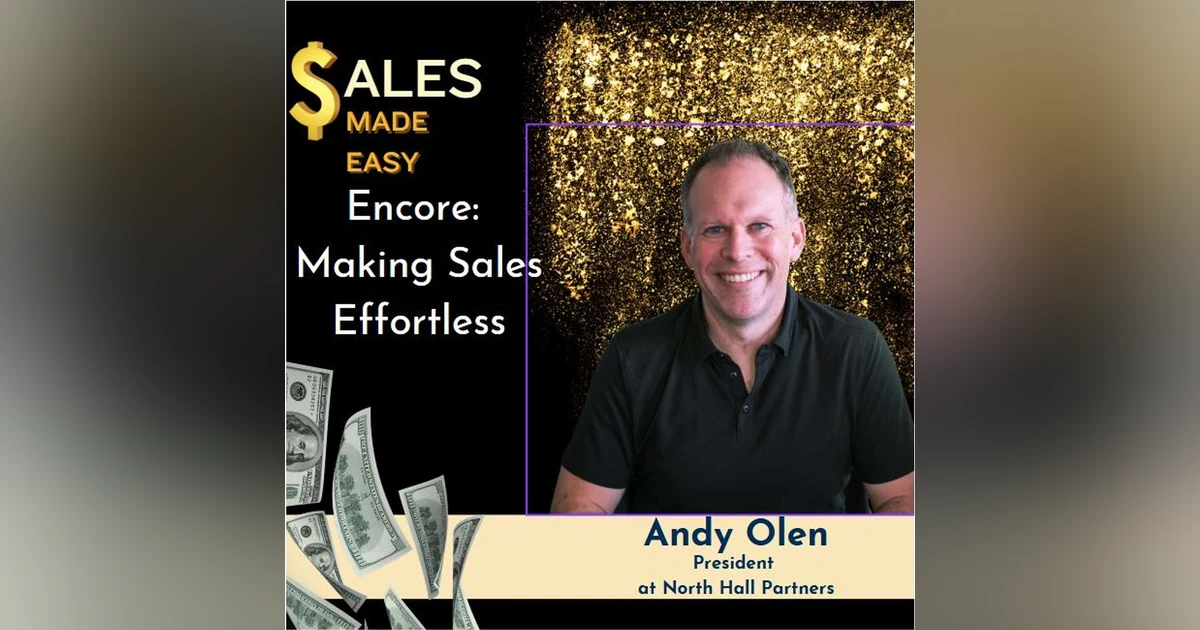


In this episode of the Sales Made Easy podcast, host Harry welcomes Andy Olen, author and sales leadership coach, who delves into the essence of effective sales.
Andy emphasizes the importance of connecting, building trust, and communicating effectively with customers, as outlined in his book 'The Trilogy of Yes.'
The conversation explores the art of closing deals through relational selling without pushy tactics, understanding customer processes, and maintaining long-term relationships. Andy shares his journey from corporate America to entrepreneurship, providing insights on navigating the transition and overcoming fears.
The episode concludes with practical advice on practicing sales pitches and handling rejection gracefully.
Connect with Andy:
Connect with Harry:
LinkedIn
https://sellingwithdignity.com/
Join my Facebook Group:
https://www.facebook.com/groups/sellingwithdignity
. Andy is an author, a sales and leadership coach, and I know this podcast will be beneficial for you.
Enjoy.
Harry: Andy, what's the good
Andy: word today?
Hey, Harry, it's great to be on the show. I want to talk about sales skills and sales approaches that go nicely in line with the title of this show. Sales Made Easy. So Easy is the word today.
Harry: All right. Fantastic. I love it.
So we're gonna go with easy and also the word trilogy. I think you wrote something about trilogy when it comes to sales.
Andy: all about? Yeah, you bet. Thanks. It's the trilogy of Yes. Is a book that I authored a few years ago. throughout my nearly 20 years in corporate [00:01:00] America and global sales roles I had a great privilege to work with salespeople all around the world and the common denominator, the common theme was that great salespeople knew how to connect effectively with their customers, build trust.
They knew how to communicate effectively no matter what language it was in. And they also were really wired to cooperate or to partner with their customers to solve their customer's problems first, knowing that if they were to solve their customer's problems, most likely the customer will reciprocate and give them the gift of a yes or a sale in return.
I authored the book, the Trilogy of Yes, which connects the skills of connection, communication, and cooperation. Three skills that salespeople can use to inspire customers to say yes.
Harry: right, so I don't hear the word close in there. So it's you left the, that c word out and it's so yeah, tell me about, I just love what you're just explained there because I, I'm in total agreement with that.
But you know, [00:02:00] obviously some people are just looking about, they want to close more, right? It always seems to go to, we struggle with closing business and that's where people go to, which is really towards the end of the selling process, but, Tell me, it looks like you're really talking about the beginning here is what I'm getting.
Andy: if you form a strong connection where you signal to the customer the similar values that you have with him or her, and you demonstrate on a consistent basis your ability to clearly articulate and. reframe the customer's problem and share with them that you really know what the challenge is, and then articulate a solution that if it were implemented, would yield a great improvement, better benefit for the customer, or when you cooperate with them to solve their problems.
Closing shouldn't be that difficult. I mean, your customer's almost gonna wanna run through the wall in some ways to get going to that if the value proposition has been outlined clearly, and they [00:03:00] trust you. That being said, I do work with a lot of teams where closing is a really stressful event.
And the Alec Baldwin character from Glen Gary, Glen Ross. And it's like, that's not who I am. That's not authentic, that's not genuine. He's not a very nice person. There, there's no cooperation there. And how he's trying to motivate those sales teams in those sales individuals. So I don't want to be like him.
So how do I do this? And how do I navigate the possibility that a customer might say no, and I don't want to deal with the rejection. the biggest failure that any political candidate can do on the campaign trail is to fail to ask the voter for his or her vote.
Can I count on your support on election day? Have I earned your vote? If you don't ask, Then the, that voter is sort of left hanging out there. It's like, oh, maybe, maybe not. But there's no commitment that's being made. And the good politicians still to this day, they ask for the vote. And I think a salesperson, just think of it that way, is that if you've done your job, you probably put really good points on the board and you have a high [00:04:00] percentage that it's gonna close, give the gift of a closing request to your customer.
So she or he can happily say yes to you. It is a great opportunity, and if you've done your job well, most likely it's gonna be
Harry: Yeah, there's a whole lot of value in asking for the business, right? so many people make the assumption that because we're talking to the person, , because we're engaged, because we even might have shown pricing, we still may stop.
and just kinda let things go and say things like, let me know if you're interested. they've already shown that they're interested. If they've gone through all of this with you, we need to do more than just that. So, yeah, I absolutely love it.
And it's just tied in with, because we think. A certain way does not mean the person across from us thinks the same way.
Andy: Let's just wanna, and you wanna That's right. And you wanna create that alignment. You [00:05:00] don't wanna leave that.
We don't want uncertainty. And so the way that you close uncertainty that maybe the customer's there maybe not, is you ask, you say do you have everything? And are you prepared and ready to make a decision? And if the answer is no, I don't have everything. Well, good that you ask. So you can close that gap.
You can remove that hanging chat and make sure the vote is clear. You know, there's a one of the styles that I've read about and I share with sales teams is like, think about the summary close. That's a really elegant way to sort of encapsulate the entire sales process, your value proposition. Hey Harry, we've talked about.
The situation that you have. I've outlined the benefits of the product. We talked about the time to install and where you'd see a return. If there isn't anything else, do you feel comfortable moving on to contracting? That's a summary approach where you sort of put it all together and really by putting together the robustness of the work that you've put in with your customer, you signal to her that it is now time to.
Call out an objection. Clear that objection, but it really [00:06:00] is time to get to that yes or no. And again, if you've done your job, most likely you're gonna have a pretty good chance of receiving and hearing a yes.
Harry: Yeah. So in a competitive situation, do you find that people are, where you're actually closing business now or is it people making decision to go.
The company or the, with you, not necessarily you, but you get notified with an email that you've been awarded in a contract or something like that. Do you see that there's still opportunity to close when people go to these extremes it's not really a bid, but they have three d.
Vendors, they've got a team of decision makers. And they get, you know, they basically are saying, give us everything you got. You ask, you know, ask for the business. They said, well, we'll let you know. And then you get notified with an email. Is that the way a lot of business that you're [00:07:00] seeing happens today?
Andy: Some a lot of the clients I work with and my past as well. I mean, if you're working on a 400 million project with One of the world's largest laboratory diagnostics suppliers they will give you the phone call unless you really aggravated them and they don't wanna deal with you at all.
And then they'll shut you down through an email. But I think the more material and the bigger the size and the more people that are involved there is, Equity that's been built inside of the sales cycle, the sales process, and the negotiation as well. And if that equity is strong, even if you're not on the positive side of that outcome, and they go with another vendor, not you, I still think that the right thing to do is to give a phone call, talk it through debrief and as a salesperson, remember, even if you are told no, don't blow up that relat.
Hey, I'm here if you need me. I'm here standing by if anything happens. Remember, we talked about a couple of other ideas that we can implement later that would be complimentary to the choice that you've made today. So stay in the game. Don't shut the door. [00:08:00] The worst scenario that I heard of and ever, never saw myself, but always I was fearful of, was a negotiation where it sort of resembles, like if you ever go to a Brazilian tr.
The Rodio or a steakhouse where you have a red side of a card and a green side of a card, and if it's turned green, they keep giving you the meat, and if you turn it red, then they stop and it's, you are in one room, your competitors are in a second and third room, and the procurement person or the customer comes into your room and says, they just went lower on price.
Do you wanna continue and give us a lower price green card, or are you done red card? And then they just keep going through the rooms. That horrified me. Never saw it. That's a conflict filled exchange, and you just gotta be really thoughtful on how you navigate those extreme situations.
Hopefully your listeners don't run into many Brazilian Steakhouse style negotiations.
Harry: You know, there are people that will use the pricing of the competition. Mm-hmm. , I mean, there's all kinds of things that go on.
They're sharing your [00:09:00] pricing with the competitor and they just, they go to war and the lowest price wins or whatever, but they're, they typically have a couple of mine that they wanna do business and they go back and forth.
I'm not a big fan of that because I've been on the wrong end of that. It's just a way to take out as much profit as they possibly can, and they say things like, well, I'm doing the right thing for the company. But you know what I think is. when you remove all the profit from your provider and they get the business, don't expect typically the best support because now you've got some disgruntled people in there.
Andy: Hundred percent. if I were to do two, let's say sales training efforts with two clients and one we worked out a great negotiation where I felt. Great about the outcome, both in terms of work and the financial outcome. My customer felt good about it too. And another one where I had to sacrifice cuz I got beaten down.
I know which [00:10:00] one I would go in a little bit more energetic for, would be the one that valued the premium that I brought to the table. and I would have to really question myself if a customer was treating me that way during the sales cycle and pushing down and trying to. Evaporate all profit.
Is that even someone I want to do this work with them, I'm going to enjoy it. Is it someone who I can be prosperous in the long term or is this a one and done? You know, when you're just starting as a salesperson and you don't have a lot of sales yet? My approach, like when I started my own business was I can, if someone says, Andy, do you train on this?
Yes. Do you train on that? Yes. How are the economics? Well, they're gonna be more favorable now cause I don't have any other customers. But you have to make some adjustments early. But once you, know, develop your territory, develop your customer base, the beauty of that is you can be more selective as a salesperson as an entrepreneur.
And you say yes to the things that are gonna be mutually beneficial and not one-sided
Harry: Oh my goodness. That just opens up. So, I mean, it's funny how these conversations can go so many different directions. You know, we thought we were [00:11:00] gonna talk about one thing and then now this goes on, and I just, I can't let it go because when you're starting a business, I've heard people say, you know, know your avatar.
You know, do what you're great at and so forth. And I believe exactly what, what you said is that you take the business in the beginning because you need to pay the bills. Eventually, you can differentiate and discern and say I'm not gonna do that anymore, and so forth. But you gotta know.
And if you don't know, you gotta, you gotta do it, right? I mean, so. explain what you were thinking there earlier.
Andy: I love it. Yeah, no, you're absolutely right, Harry. And that's, that was my approach when I left corporate America. I mean, I have three teenage kids. I have a mortgage payment. I still have bills to pay.
It wasn't the time in my life to be incredibly selective. if you are going to build a product, sell a product, build a business, then you have to be super focused on your [00:12:00] target market. Here's my advice, here's the caveat on that. If you've built up and had a career in a certain area, you're arguably one of the world's foremost experts in that.
For me, it was in healthcare, sales, healthcare, marketing, healthcare leadership companies working with hospitals. I like to think that I've had experiences that are very, very unique and valuable. With that said, what I.
Did for myself. And what I'd encourage entrepreneurs to do when just starting is stay in your safe place when you begin. So what does that mean? There were some friends of mine that said, oh, now that you're out on your own, aren't you excited to go work and and work on sales training with high tech companies or with real estate companies?
But all my business came outta my network in my first two years, and that was working with healthcare companies. Stay in the safe place. That's fine. Cater to that. You are a subject matter expert in that. And then use or incubate and work with. Those customers to really fine tune your products and then those products can be really then offered into the broader healthcare market or [00:13:00] expand into other areas.
my advice for those who wanna step out into entrepreneurial endeavors or who are even stepping into brand new sales territories and establish companies is go to your strengths. Stay in your safe place. Understand what you're really good at. Start there. Get going and then develop and expand from there.
Harry: right? This is a language you already know, so why not take advantage
Andy: That's exactly right.
Harry: So can I ask why you left?
Andy: I left because the further up I went in leadership roles, my customer changed a ton. So what does that look like?
Well, when you start as a salesperson, let's say in a big company, fortune 500 company, you got. Pharma job, or you get a great business to business sales role. Your customer is the end user of your technology, most likely. So if I sell a pen, I'm gonna go sell to people that are gonna use pens and talk about the attributes and be very satisfied when they say, Andy, I'm buying your pen.
And as you move up in an organization, your [00:14:00] customer moves closer and closer to the owner of the company, which could be a shareholder and a publicly traded company. To the board of directors, which is the voice of the company to the public, the private equity team that owns it, the venture team or the family that owns it.
And as I moved up in the organization, all of my selling was internal and to the owners to tell them, here's how much revenue we're gonna bring in. Here are all the risks. Here's how I would guide Wall Street. I just miss selling to the people using the products.
And so I said, you know what I'm better at selling to end users and helping salespeople sell to end users. I'm not very good at like selling to board of director people. I can do it. I just don't like it as much. And so I said, let me start my own company to focus on a truer passion. And that I did that in 2019.
And I like to think I retired from corporate America, yet all my clients are big corporations. So I have sort of one foot in, one foot out,
Harry: Oh my goodness. So did you just get up and leave? Because I hear people who are entrepreneurs [00:15:00] and they just quit their job and say, I'm gonna go do this on my own.
Andy: No it was a rolling sort of process. Every time I got really sort of, we have those exacerbated moments or just I'm, sick of working in this job. It's just a bad day, bad week, nothing's going right. In those moments, the way that I would sorta.
Soothed myself. It wasn't with a nook like a baby, but what I would do is I would sit down at the computer and I'd start writing a business plan for my own entrepreneurial venture. And so thinking about being my own boss became sort of the remedy for the really tough moments. And in that process, I started actually writing the book, the trilogy of Yes as well.
I needed an outlet. I needed something that I felt I own. And I can create, and I have liberties around it. And so as I started building those things, I actually got the book published while I was at Siemens. They obviously knew about it. And then all of a sudden someone calls me up and says, Hey, can you speak on that?
Oh, can you work with our sales team on that? And it was at that point where I said, I think the book and the ideas [00:16:00] are enough of a seed. For a new business. I wanna water that, but I can't do that while I am a senior executive at Siemens Healthcare. So that's where I worked with my boss and others and said, let's figure out a plan that works for you, that works for me.
And I stepped out in June of 2019 sort of already running into my new company. my new opportunity.
Harry: what benefit was there for you that maybe some people just. Think of when they do the, I am so done with this place. I just gave my notice.
I'm frightened. I know I'm gonna succeed. And they just throw in all the chips like that versus the way you did it.
Andy: There are I'm, a F1 Formula One race fan. And formula One, they do a parade lap before a formation lap before the race starts.
And then they all stop their cars on the grid positions, the pole position in the front, and the last car, the 20th car in the back, and then the red lights. Tick down and then turn off and the race starts. They're doing zero miles an hour and they hit that first [00:17:00] corner doing 150 miles an hour. And there are a lot of accidents that happen up there.
And then the race sort of forms itself, but it's this very chaotic start. If you start your business because you're angry one day and you said, screw it, I'm gonna go out and do my own thing, you're gonna shoot outta the gates.
But you might run into an accident right into the first corner because you haven't given yourself that time to prepare that time to get things going. So it might be a rough start. I guarantee you, you will do well if you stick with it, you're determined and you have a good product to offer. The way that I did it was a rolling start.
So the Indianapolis 500, they get the indie cars going a little faster, a little faster around the track, and then the green flag comes down and they're doing 200 miles an hour after they go past the starting line. I wasn't going 200 miles an hour past the starting line, but I was probably going 75 miles an hour.
there are fewer crashes at the start of the Indy 500 because they're already up to speed. So I think you just have to check your personality, understand what's best for you. Either way is fine. I'm a planner. I would encourage people to plan it out a little bit before you just [00:18:00] sign that resignation letter, hit the send button, and you are like, this is great.
I empowered myself. Now what do I do? I have no
Harry: idea. .
Andy: No.
Harry: can I ask what was like a big fear of yours when you were doing the Rolling start?
Andy: how you overcame it?
Yeah. Fear of rejection, right? That you've built something that isn't good and what you and, you know what, there's some truth in that, that you do build things that aren't good. The good news is if you stick with it, the marketplace will tell you. This was, this part of it was really good, and so keep doing more of that.
But this other thing over here didn't work out real well. I have a training almost every week as we, there are still things. It's like, all right, this is a new slide, or a new joke or a new concept, and I'm really paying attention to how the audience reacts to see if I have something good or if it's not well received or confused or not understood.
I either have to develop it more or I have to move on from it. So you have to be ready to iterate in your [00:19:00] products, in your technology, in your services, whatever it is you're gonna offer. Be open to that critique, evolve quickly, move forward, keep changing, and then surround yourself with smart people that can help you out and give you a perspective as well.
Harry: . I was having a conversation earlier where people who are not in sales, They're typically going into the most important conversation right after they've built up all of this time and value and connection with a person.
They have to ask for the business, and they frequently do this off the cuff. And there's no rehearsal, there's no preparation, and they just do it and then they're, not happy with the outcome. Is rehearsal something that you recommend, like some kind of role playing, speaking in front of a mirror, writing things down?
What's your advice for someone who's trying to write business and maybe doesn't have the sales coaching that [00:20:00] you.
Andy: Closing as we talked about earlier, is an awkward moment. You don't want the no, you don't want the rejection. At the same time, you need to have a decision made so everyone can move forward.
I'd encourage your listeners to look at it this way. Give your customer the respect and trust of asking for the business. When I'm asked to make a decision by a salesperson, a vendor, a general contractor, whomever that has done a great job. To me that's a level of respect. It's like, hey Andy, I'd love to have your trust in me.
Are you ready to move forward? And I'd love to do this work with you. Thank you for asking. Yes, I would so turn that around that it's not a taboo situation. It is the invitation for your customer that you extend to them to say yes to you. Give them that platform because they might just assume that we're gonna go forward, or they might assume that you already know that it's happening.
But you may not know that as a salesperson. So it just is that clarifying [00:21:00] moment. Give them the respect of that and yes. Practice. And I think there's a balancing act. I always encourage people, you great salespeople, and you probably know this was selling with dignity, is that being authentic and genuine is just a wonderful sales skill to have to, it's a wonderful interpersonal skill.
It's a wonderful sales skill. People follow genuine and authentic people Make sure that you find the words when it comes to closing that are genuine and authentic to you. But Harry, we've been working on this for a long time.
I'm really excited to take the next steps with ya. Are you ready to put together a contract so we can make it happen? That's, you know, Some people might say, Andy, that sounds really salesy. I don't think so. That's just me. And I'm excited about the journey that we're gonna have. And the next step in that journey is putting a contract together or closing and just enjoy that process, but have it rehearsed.
And then once you do it a handful of times, you're gonna see that, you'll find your way, you'll find your words, and you'll make those adjustments like Chris Rock does, and Larry David and Jerry Seinfeld and any great salesperson, entrepreneur as well.
How do you [00:22:00] close with dignity?
Harry: Yeah, I'm enthralled just listening to you. I just love listening to you and so, you know, I think it's just completely natural. the more you can just get into the natural, I don't remember closes. if someone has a book. I mean, I know there's a lot of books out there and I've read some of 'em where, you know, you're trying to remember closes and so forth.
The alternative clothes and, you know, all of this stuff. It's just like, none of that's ever worked for me So I just like to ask people, well, how's this looking Right after we've had the conversation? So what's your feeling on all of this? How is this looking? Do you feel like this could be reality where we do business together?
And then having some enthusiasm and smile. Yes. Cause I think people, if you fear it, they're going to sense that, right? So if you just become chill and say, and you know, the line I use frequently is nobody's dying. [00:23:00] You know? Yes. A lot's riding on it, but nobody's dying for crying out loud. So have some fun with it.
if you can make 'em laugh, they'll buy from you. you have fun throughout the experience. You can pretty much say, Andy, what do you think? Are we gonna make this happen? Or what? How's this looking right? And it depends on the size of the deal.
I'm not gonna do that on a 400 million deal unless we're having lunch or maybe on a golf course. And then there's that feeling where you can say that stuff,
Andy: I agree with that. I've been working with a long-term client, but we're about to kick off a high potential leadership development course.
and that's what I'm finding in this recessionary moment that decisions. are just taking a little bit longer. Instead of pushing hard to close, I just informed her of what the next step was.
Hey we're at a point where I'm ready to put together a statement of work. Do you think we're at a good time for me to put that together and send it to you? And then I checked in with her a couple weeks later and just said, Hey, just wanted to confirm that you had a chance to get all this stuff done.
We got on the [00:24:00] phone and started talking through some things. She asked some questions and I said, Hey, last time we spoke it was time to put that statement of work together. How about now? And she's like, yep, get it to me as soon as you can. And I think there's, nothing slick about that. That's just the process. And again, I think you're giving the gift of certainty, awareness and transparency to your customer. And I think in a lot of those words, especially transparency, genuineness, just being yourself, smiling as you said, laughing having fun with it.
Harry: Yeah, and I think, I mean, you just said it perfectly, you reminded me of James Mira's book, the Perfect Close, and that if you haven't read that book, folks, I mean, that is such a gem And find him on YouTube. He just makes it so simple. You're closing throughout the sales process.
I'm not even a fan of the word close but you're just moving the sale, as you just said. You're moving it forward and people need to know what that means. So
This is what we do. They don't buy that [00:25:00] frequently unless you're buying a commodity. They're buying groceries or something. But if you're in whatever you're selling, houses, cars, it services, technology. They're not buying this every day. So they don't always know what the next step is. And so laying it out nicely, like you just did, you know, saying normally at this time people will typically do this.
Does that sound like a good next step? Whatever that is, right? Does that sound like a good next step? And the answer is, well, I don't think I'm ready for that. Then you just throw it back at them and. Well, what, what would you say is a good next step? Right. Just so dang easy and smooth and simple.
Andy: Yeah, and it's genuine, it's authentic and that's how life works too, right? I mean if you're trying to solve a problem with a friend or work through like if you and your partner are, doing a home remodeling, Hey. All right, we got the drywall up.
What's next? Okay, well, we gotta get the crown molding on, right? you wanna know what's [00:26:00] coming up so you can get to this beautiful end product. And I think it's just that easy. Don't be afraid to ask and don't be afraid to share what's next for you as a salesperson. Don't be afraid to ask.
What would you need next? Or what is your next step? And if the customer says, I think we have everything here. Great. Would you like me to put it down in the form of a contract, a statement of work, a purchase order? Are you ready for that? And a lot of salespeople will miss.
Especially towards the end they'll miss and not be aware of what the sales process looks like. And so sometimes you'll ask and the customer will say well, once I approve, there are two or three more approvers above me that have to say yes as well. It's like, oh, okay. Now that you asked or you tried to move towards a close, you now have.
Revealed more of the process in front of you. Good. So your closing line, even if it doesn't get you to a yes in that moment, it might reveal all the final steps to get you there. And that knowledge is super valuable for a salesperson rather than it being a random walk.
Harry: my goodness. [00:27:00] Yeah. So just understanding the process, how does someone do that?
Andy: Because if you are surprised, especially if you're working for a big company, I have a big quota and it's the end of the quarter. If you're surprised that there are four more steps in the process, instead of closing that $25,000 deal, and then you tell your manager and she says now you've surprised me too.
You got. Unhappy internal customer and your manager, and you're not hitting your quota. But if you can uncover that with another month to go in the quarter, oh, good. I'm glad I figured out there are three more steps. I still have 30 days to get it done and I can deliver. So a closing approach or mindset is really just a next step, and then it's just that courage to step out there saying.
I think we're at the end. Let me summarize what we've done together. Are you ready for me to put this into a contract? And if they say yes and they continue to engage with you, boy you're really well on your way to get into something great at the end.
Harry: it's like, this is where the questions, I mean, I know you know this, but the buying [00:28:00] questions that people have, if they're not giving you any buying questions, is that a cause for.
Andy: Yeah, especially late. You know, buying questions such as if I were to order, how long would it take for it to arrive? What could be a, like a go-live date on this new software? If we were to move today, what's, the pricing is often a buying question. The more that a customer's asking you if a customer's never asking you any questions, that's a red flag for me.
But if the customer's asking questions, I always like to think about it in terms of calorie burn. They're burning calories, they're spending time, they're thinking about questions, which is a calorie burn. They're admitting the question verbally, which is a calorie burn, and they're willing to listen to you in response.
And if they're giving you that many calorie, They're probably signaling that they're very interested if they're not asking anything. And if they're quiet, that is usually a, a signal that one, they've made up their mind to go to a competitor or they're just extreme introverts and they're not giving you a lot.
Or they're extreme customer introverts who [00:29:00] are not giving you a lot because they don't want to have any connection. They wanna try to hold that as leverage later on in a negotiation. But yeah, I think engaged customers are gonna ask a lot of questions and you're gonna hear it. And if you're hearing buying questions sounds like, Hey, everything's moving in the right direction, what other questions do you have?
If not, are you ready to take the next step? Which would look like this.
Harry: And when you start hearing those buying questions, do you feel like you. Jump on that or just let it go and waiting for the next meeting or something.
Andy: Personally I like to, if I'm getting really strong buying signals, and by the way those buying signals not only come from verbal signals, it's non-verbal as well, especially if you're in person or watching over teams or Zoom or WebEx.
you can see the level of engagement. I don't wanna leave that meeting with ambiguity around what their intent is. So I might even call it out. Now, if I know the customer pretty well and there's trust, I can just say, Hey, it looks like. [00:30:00] You're liking where we're going with this. Am I reading that correctly?
Just call out what you see and you know, no one gets offended by that. I mean, if it's an appropriate question and they're really engaged with you, just say it. It's like, Hey, you look pretty excited about this. Am I reading that right? You know what I am. And here's why. Great. that's what I was hoping to hear.
What would you like to do? Mr. And Mrs. Customer, and they might say, I dunno, let's contract this thing out. Let's go. would you move quickly on the, if you see it
Harry: Totally . Yeah.
Well, based on your reaction, you know, and you just have that, it's like, and they'll typically come back with, if they can't do anything, then they're just gonna make it so dang easy for you. But they wouldn't have said anything. If you don't call 'em out, I don't think, I mean, it's like agree,
Andy: You gotta prompt, you gotta ask for the vote. Gotta prompt. Yeah, there you go. You gotta ask for the vote. Don't run a great campaign and fail to ask for the vote and expect to win. Go out there and it's like, Hey based on everything I told you about my policies and positions and what I'm gonna do if elected how do you [00:31:00] feel about that?
Yeah, I feel pretty good. can I count on your vote on election day? Yes. Fantastic. That verbal commitment then is often binding. It's like a social contract that's written prior to the lever being pulled. And we've all been there as salespeople where you get the verbal Good salespeople never put the verbal in the bank, good salespeople will update and say, we're heading down the right path. But what you put in the bank is a signed contract. the signed purchase order or payment for the invoice, right?
That's what goes into the bank. But yeah, the verbal is a, it's skin in the game. It's face or credibility for the customer. And by the way, if they give you a verbal and then rennee on it and pull away from that, That's, there's an opportunity there for salespeople to follow up and say, okay instead of saying, well, why don't you tell me later on when you wanna engage in this, ask for something right away because that, that customer probably feels bad about.
Saying no after they said yes. Okay. Would it be possible then to talk about this other opportunity that we were gonna wait six months on? Can we bring that [00:32:00] forward? Yeah, I guess we can. So don't run away from the customer who says, I'm sorry, I said yes. Now I gotta say no. Stay in there because there's probably a human emotion out there that they wanna make up for them.
Disappointing you. Stay close to them. Don't run away.
Harry: do you have a horror, a verbal horror story?
Andy: I think I've had many verbal gerbils before. it always would be this, is that the customer said yes. And then I would ask like, as a sales leader, all right we're getting close to the end of the quarter.
What's the next step? And then the salesperson, these are a collection of my horror stories. the salesperson would just say, I'm waiting for them to sign the purchase order. And then my retort to that would always be, salespeople don't. the verbal has given that customer a free pass, and you now have, are not taking any action.
You're just in a waiting game. Well, what is your follow up? What is your next step? Always gotta be leaning forward, leaning in because great salespeople don't wait. So I think my horror story is anytime someone said [00:33:00] my next step is waiting, and I'd always have a pretty adverse reaction to that.
The decision is with this individual. They have committed to getting me an answer by Wednesday. I'm going to remind them on Monday, and I'm gonna follow up in person on Thursday if I don't get that answer.
perfect. You have a plan. I appreciate that.
Harry: something.
Andy: Yes, I will get something certain and I'm working it.
Harry: Thank you. My, my worst verbal story is getting the verbal on Friday afternoon and me saying, I'll see you Monday morning to sign the paperwork. And when I got there on Monday morning, the guy looked at me like it was death warmed over and he says, I hate to tell you this, but your competitor came in on Saturday morning with an offer I couldn't refuse.
It was a rainy Monday morning in the Washington DC area driving through traffic, and the only thing that kept me going was, I'm gonna get a deal. I'm gonna start off the week or whatever. And then I got that bad news and I, I, there was no hiding the emotion.
I'm sure I probably tore [00:34:00] into the guy a little bit. . But I ended up getting business afterwards. Talk to me about that. what's a good thing for people to pick up based on your philosophy, even when things don't turn out right at the
Andy: Yeah. As I write in my book, great salespeople, they connect, they communicate, they cooperate. And they also realize that sometimes it just doesn't go your way. I've never met a salesperson who has won every single. I lost a deal this morning. I anticipated that it was coming. for me, no is the start of the sales process, not the end.
on Friday you thought you had the deal. Monday morning it was a no. And you could have done two things very easily, been angry at that person and impaired the relationship. Or said, screw it, I'm never coming back here again.
I'm just. And, ghosted or abandoned that account, you stuck with it. And that goes back to what I said earlier is that if you stick with it, even in adversity, I think people recognize that. It's sort of like the I did a Ted TEDx talk a long time ago and there was unfortunately one speaker that came in the afternoon that day who [00:35:00] just.
Forgot. He forgot his speech halfway through. And it was a challenge. And everyone in the audience, you know, you empathize for that person. You want them to find the words, you want them to get back up. And he did. And it was almost like a collective sigh of relief. And then a huge applause at the end.
So he empathize. And I think customers are actually the same way. They're, it's like when they disappoint you, if you stay there and absorb it and take it well and continue to be positive. What does signal that is about you and your company and your brand about what you'll be able to deliver long-term is that you're not gonna abandon them.
And if you stick with it, I do think you're gonna get rewarded
Harry: You have to have an ego. But the old cutting the nose off despite your face, I watched people when they would lose out on a five year, office technology typically came up every three to five years on leases and if they didn't win the deal, they got nasty with the buyer.
And I think, what do you not think that three years is going to pass, [00:36:00] that they're going to make a decision again. You know, it's like, I don't care about three years from now, I'm only concerned about today. And, you know, that type of thinking is just, you gotta look at your business as being in the long term.
right?
Andy: Absolutely. I have a good friend who's a mortgage lender, mortgage broker, and he is very upfront with me and other clients really good sales skillset is that, look, if you're looking for a quarter point better mortgage rate,
Wells Fargo or one of the big banks is gonna give that to you. Here's what we will do. we're gonna white glove treatment, your mortgage from inception to close. When you say, this is the closed day, we will have it closed this day. We'll answer every question, return your call within a couple hours, do X, Y, and Z.
And, but I understand that you're gonna go choose the lower interest rate from the big. He said, Andy, eight out of 10 times those people that choose to walk away from us or a lost deal, go to the big bank, they come back again. The big bank missed our close date. They don't respond to any calls. I can't do it anymore.
Can we lock in a [00:37:00] rate together? And then we have this long-term relationship. He said that's a much. Better business approach and selling approach to treat, treat people that are gonna exit with grace, with dignity, with, Hey, I'm still here for you if you need me. Versus, you know, that's a dumb decision.
Screw you. Don't come back. I said, if you offer something really good, they're gonna come back. And I think that's a really valuable lesson for, everyone listening.
Harry: It's so good. The yeah, and just telling people that you're gonna find out or you'll see or you don't welcome 'em back with the I told you so ,
Andy: No, you don't. I'm glad you're back. Thanks for coming back. I'm sorry you had that experience. And then they'll usually say, you were right. Yeah. And you don't have to say Yes. I was, look at me now you just like, Hey, let's get it done now. And then you execute, deliver, and you got a customer for life probably.
And 10 references coming from that person.
Harry: Andy Olson. have I been saying your name wrong?
Andy: No, you got it right there. Oland.
Harry: wanna sign something from you. I love the way that you approached sales. Any final thought that you would like to share
andy olen1: with
Andy: Yeah, I would just go back to our [00:38:00] word of the day. remember, great selling skills like connection, communication, cooperation, being authentic, selling with dignity, being genuine. These are also how we build relationships in our personal life too. So always go back, look at your personal life.
Look at the best relationships you have. They're probably built on a great connection. Wonderful communication, solving each other's problem with cooperation. You're authentic, you're genuine, you're your best self around the people you're closest to in your personal life. Just bring all of that right into your selling life, and those skills are a hundred percent transferable,
Harry: Thank you so much. And where can people find you?
Andy: Andy oland.com. A n d y o l e n.com. The book is the trilogy of Yes, and also my podcast the Sales Warrior within which you've been a wonderful guest on Harry. So thank you for that. And all of that. You can find it through my website@andyoland.com.
Harry: appreciate you visiting me, man. You have made sales easy again, so thank you so much, ed.


